
Epigram | Why sustainable design often starts with small decisions
When organisations talk about sustainability, the conversation usually focuses on big operational changes, things like energy use, travel policies, supply chains. All important, of course.
But one area that often gets overlooked is how brands actually function day to day.
Design decisions, the templates teams rely on, the materials they produce, the way information is shared, quietly shape a huge amount of organisational output. And often, the easiest sustainability improvements sit right there.
At Epigram, sustainability has become an increasing focus both internally and in the work we do with clients. Earlier this year we were proud to be awarded EcoVadis Gold, recognising the progress we’ve made in strengthening our policies and practices. Platforms like EcoVadis are also becoming increasingly important for organisations that want visibility into the sustainability standards of the suppliers they work with.
But beyond policies and reporting, sustainability often shows up in much more practical ways.
Rethinking something as simple as a business card
One small change we made recently was moving away from printed business cards.
They’re a long-standing networking tradition, but also a surprisingly inefficient one. Cards are printed in batches, carried to events and often left unused, or quickly become outdated when someone’s role or contact details change.
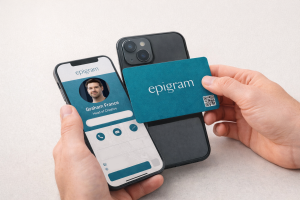
Instead, we moved to digital business cards. We chose Tapzo, although there are several providers offering similar solutions.

Using a small NFC-enabled card, you simply tap it against someone’s phone and your contact profile opens instantly, allowing them to save your details straight into their contacts.
It was quick to implement, easy to brand so it still feels like part of the Epigram identity, and far simpler to manage across the team. Most importantly, it removes the constant cycle of printing new cards whenever details change.
A small shift, but a surprisingly practical one.
Where design can support sustainability
Business cards are just one example. Increasingly, we’re seeing opportunities to bring more sustainable thinking into the way brands operate every day. Often the biggest gains come from improving systems rather than making dramatic changes.
Smarter templates
Many organisations produce huge volumes of presentations, proposals and reports. Without structured templates, teams often rebuild documents from scratch or rely on outdated files.
Well-designed templates make it easier to create on-brand content quickly, reduce duplication and encourage digital sharing instead of printing. They also extend the lifespan of brand assets across the organisation.
Designing for digital first
Another shift we’re seeing is towards digital-first communications such as presentations, interactive documents and social content replacing traditional printed collateral.
Print still has its place, but when brands are designed with digital use in mind from the start, teams often find they simply need far less of it.
Building brand systems that last
A well-structured brand toolkit can dramatically extend the life of design assets. Instead of constantly producing new materials, teams can adapt existing templates while keeping communications consistent.
Sustainable design is rarely one big decision
More often, it’s the result of lots of small improvements, a smarter template here, a digital alternative there, a brand system that works more efficiently for the people using it every day.
For organisations thinking about sustainability, design is often an overlooked place to start. But it’s also one of the areas where relatively small changes can reduce waste, improve efficiency and make brand systems easier for teams to use.
And if nothing else, switching to digital business cards means you never have to remember to reorder them before a conference again, which, after years of last-minute print runs, feels like progress in itself.