
Smarter drafter: The last integration you’ll ever need to build
Our Product Manager, Tenzin Lama, has been heads-down with our latest MCP release, and to say he’s excited would be an understatement.
In his own words, he thinks it’s a fundamental shift in how legal documents get drafted, and how the integration layer that firms have spent years (and serious money) maintaining is about to become a thing of the past. We’ll let him explain why below:
I’ve spent years watching legal tech teams do the same thing over and over again.
A firm wants data from their practice management system to flow into a document. So someone builds a connector. Then they want it to flow the other way. So someone builds another connector. Then the PMS upgrades, or the document platform changes an API, and someone has to go and fix both connectors. Then the firm adds a DMS, and the whole thing starts again.
This is the integration layer. It’s expensive, it’s fragile, and every firm I’ve spoken to has a version of it held together with custom code and institutional memory. And it just became unnecessary.
What MCP actually changes
The Model Context Protocol is an open standard that lets AI platforms (Claude, Copilot, whatever you’re using) discover and call external tools directly. Not through a custom connector. Not through a hand-coded field mapping. Through a standard interface that any MCP-compatible platform can understand.
Here’s what that means in practice.
Before MCP, if you wanted data from your case management system to populate a document in Smarter Drafter, someone had to build that bridge. A developer had to say: this field in your PMS maps to this field in Smarter Drafter, formatted this way, with this validation. Every. Single. Field. And when either system changed, someone had to update the mapping.
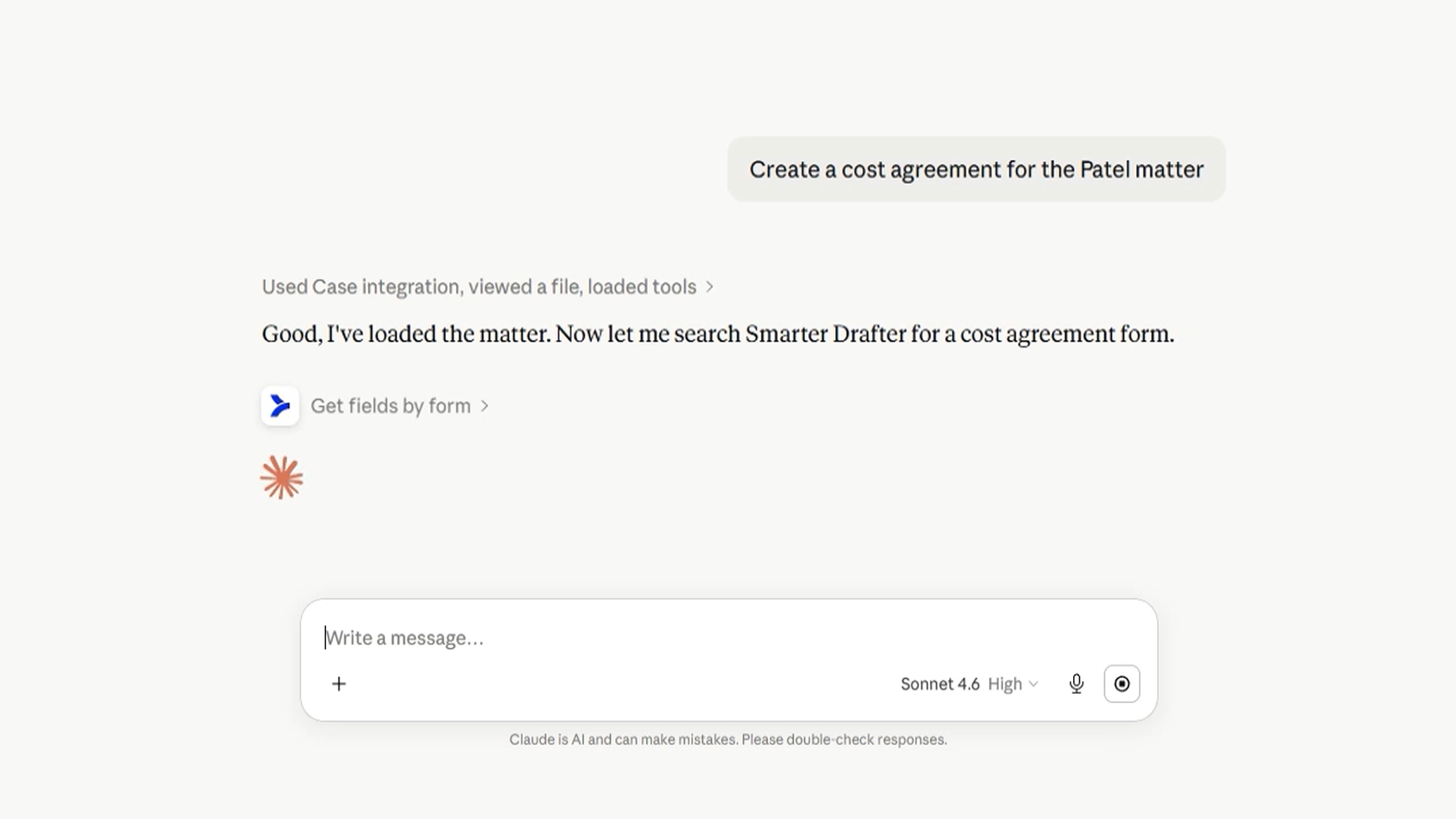
With MCP, you give the AI a task – “draft a cost agreement for the Smith matter” – and it works out the rest. It looks at the matter in your case management system. It finds the right form in Smarter Drafter. It figures out which fields map to which data. It asks for anything that’s missing. It submits. It brings back the document.
I didn’t tell it how to map the fields. I didn’t build a connector. I wrote a two-line skill that said: when drafting documents, use Smarter Drafter.
Two prompts. One cost agreement. No integration work.

The part nobody is talking about
There’s a category of legal tech businesses built almost entirely around being the integration layer. Tools whose value proposition is connecting System A to System B so data flows between them without rekeying.
I’m not going to name names. But if your product’s core value is “we connect your PMS to your DMS to your document platform,” I’d be having some serious conversations right now.
Because the AI doesn’t need you to do that anymore. It can discover the tools, understand the schemas, map the data, and orchestrate the workflow itself. The integration layer, the thing that took weeks to build and months to maintain, is now something an AI handles in seconds.
This isn’t a distant prediction. I demonstrated it last week. Live. In front of a customer. Using real data.
What this means for Smarter Drafter
Here’s the thing: this shift actually strengthens our position rather than threatening it.
For a long time, Smarter Drafter’s value was partly about the integrations we’d built: connections to iManage, to practice management systems, to the tools firms already use. Those integrations took real engineering effort and gave us real market differentiation.
But the honest truth is that anyone can build an integration. APIs are public. Connectors can be replicated. That was never going to be our moat long term.
Our moat is precision document generation.
What AI can’t replicate is thirty years of legal drafting logic encoded into firm-approved precedent templates. The conditional clauses. The jurisdiction-specific logic. The defined terms that are consistent across a 40-page agreement. The document that comes out looking exactly the way your firm intended, every single time, with a full audit trail.
That’s what Smarter Drafter’s MCP Server delivers:
- The AI brings the intelligence – the conversation, the data gathering, the orchestration.
- Smarter Drafter brings the determinism – the firm-approved template, the rule-based assembly, the output that is identical whether it’s generated at 9am on a Monday or 11pm on a Friday.
We are the drafting infrastructure. The AI is the intelligence layer. MCP is what connects them.
What I’d say to legal tech builders
If you’re building in this space, the question to ask is: what part of my product requires genuine expertise that an AI can’t replicate?
For us, that’s the document itself. The legal logic. The precedent library. The deterministic engine that guarantees the output.
If the answer for your product is “we connect things together”, then that’s the part that’s under pressure. Not immediately, not completely, but the direction of travel is clear.
The good news is that MCP doesn’t just threaten existing integrations. It also massively lowers the cost of new ones. Building an MCP server is straightforward. I built one in a few hours. The firms that move fast to expose their capabilities as MCP tools will find themselves part of every AI-orchestrated workflow in legal. The ones that don’t will find themselves bypassed.
The two-prompt future
I ran a demo recently where a lawyer went from “draft a cost agreement for the Patel matter” to a completed, firm-approved document in two prompts. The AI pulled the client data, identified the form, noticed a fee was missing, asked for it, and submitted. The lawyer never opened Smarter Drafter. Never touched a form. Never mapped a field.
That’s not a prototype. That’s running in production today.
The integration layer had a good run. But the last integration you’ll ever need to build is an MCP server, and once that’s done, the AI handles the rest.
– Tenzin Lama is Product Manager at Smarter Drafter. He builds things and has opinions about them. Connect with him on LinkedIn.