
How to make AI a genuine productivity gain for lawyers-LexisNexis
There is no shortage of AI usage in large law firms. Lawyers are already using it for research, knowledge management, document review, document analysis and drafting. In many firms, adoption has moved faster than the internal structures needed to support it.
It is tempting to assume that if lawyers are using AI, the firm is becoming more productive. But that does not always follow. A tool can produce an answer quickly and still leave a lawyer with more work to do. It can speed up drafting while increasing the time needed for checking, or help with research while creating uncertainty over sources, accuracy and accountability.
For CTOs, this is the awkward middle ground. The firm wants the productivity gain, lawyers want tools they can trust, and clients want reassurance that their data and matters are not being used as a test bed.
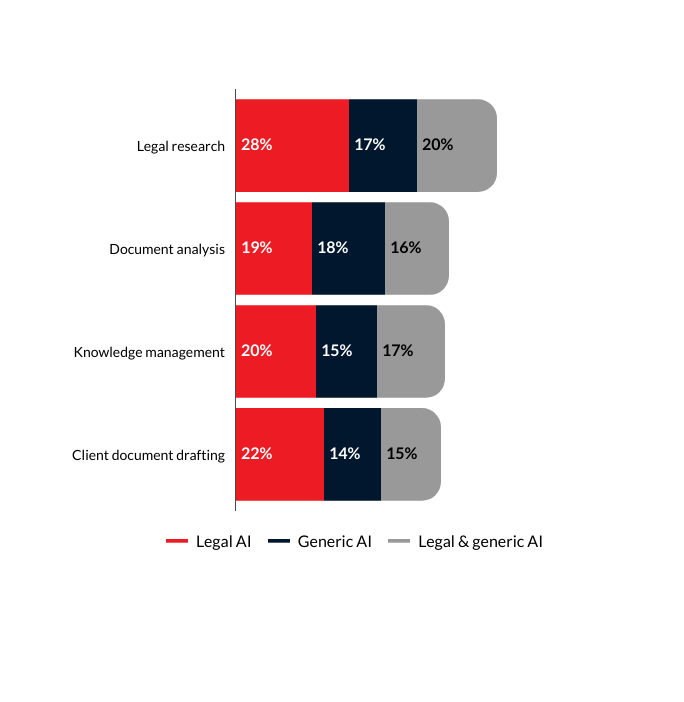
Our survey of private practice lawyers in large law firms found that four-fifths use AI tools for legal research, while roughly two-thirds use the technology for knowledge management, large-scale document review, document analysis and client document drafting. Yet only 30% of legal professionals at large firms said AI is embedded in their team’s strategy and operations.
That gap is where much of the work now sits. Lawyers are experimenting with AI faster than firms are integrating it into the way legal work is actually delivered.
Productivity is not the speed of the first answer
The productivity gain from AI does not come from producing something quickly. It comes from whether the whole task becomes easier, safer or more consistent.
A draft produced in seconds is not a productivity gain if it takes longer to check than it would have taken to write. A research summary is not especially useful if the lawyer has to retrace every step because the sources are unclear. A document review tool does not add much if the output cannot be explained, audited or trusted.
The better measure is not speed of answer, but time to a safe answer: the point at which the lawyer can confidently stand behind the work.
Alex Bazin, COO & CTO at Lewis Silkin, says adoption without implementation will limit the value.
“Very few firms have rewired their underlying processes, feedback loops, and expectations to drive consistency of usage. Until that happens, the gains from AI will stay trapped with individuals rather than compounding across the firm.”
Individual lawyers may become faster at individual tasks, but the firm does not necessarily become more efficient unless those gains are built into shared workflows.
The use case has to earn its place
Not every task is a good AI use case, and not every good use case should be scaled immediately.
The first question is whether AI reduces total effort, rather than moving work from one part of the process to another. If the tool helps a lawyer find the right source, compare documents faster, identify inconsistencies or produce a useful starting point, it starts to justify its place. If it creates uncertainty, duplication or additional checking, the gain may be weaker than it looks.
For Oliver Bethell, Chief Technology Officer at Travers Smith, the nature of legal work creates practical limits.
“A lot of what we do as a firm is bespoke and complex, and doesn’t lend itself to automating end-to-end.”
That does not make AI irrelevant. It means firms need to be realistic about where it fits. The strongest use cases are often not the ones that promise to replace whole activities. They are the ones that reduce friction around legal judgement: research, summarisation, document comparison, clause review, first drafts, knowledge retrieval and large-scale document analysis.
AI has to sit inside the work, not beside it
A productivity tool that sits outside the workflow will only go so far.
If lawyers have to leave their normal systems, copy material into a separate tool, interpret an answer with limited context and then manually bring it back into the matter, adoption may happen, but integration will lag behind.
Mark Rendall, CIO at Taylor Wessing, describes the issue clearly.
“Many firms are seeing experimentation and pockets of use, but without clearly embedded use cases, these don’t translate into sustained, organisation-wide impact.”
AI needs to fit the way lawyers actually work. It should connect to approved sources, secure systems, matter workflows, knowledge assets and review expectations.
Hélder Santos, Head of LegalTech and Innovation at Bird & Bird, says the biggest barrier is trust.
“AI needs to be carefully connected to a firm’s systems, processes, and ways of working, in a way people actually trust and use.”
Bad data will kill the productivity story
AI cannot deliver reliable productivity gains if the firm’s data is fragmented, poorly labelled or trapped in silos.
Jason King, Head of Platform at Taylor Rose, sees poor data quality as one of the biggest barriers to scaling AI.
“Legal data is often fragmented across systems, inconsistently labelled, and embedded in siloed workflows, which limits what AI can reliably do at scale.”
That is a productivity issue, not just a technical one. If lawyers cannot trust what the tool is drawing from, they will spend more time checking outputs. If documents, precedents, matter data and knowledge assets are not organised in a way that AI can use safely, the benefit will remain limited.
Trust is part of the time saving
Lawyers will not treat AI as a productivity tool if they do not trust what it produces.
Our survey found that 85% of legal professionals at large law firms are concerned about relying on inaccurate or fabricated information. That concern is not a cultural barrier to be pushed aside. It is part of the professional standard the technology has to meet.
Bethell says trustworthy AI has two dimensions.
“Trusting that the data is secure, and trusting that the model will produce reliable answers.”
Both matter. Lawyers need confidence that client data is protected, but they also need to see where an answer came from and how it can be checked.
The ability to verify is central to productivity. If a lawyer can move quickly from output to source, from summary to citation, from recommendation to supporting material, the tool reduces effort. If they have to reverse-engineer the answer, the time saving disappears.
For CTOs, the productivity challenge is not solved by licensing another tool or encouraging more experimentation. The real work is more operational: identifying use cases where AI reduces total effort, embedding tools into workflows, improving data quality, grounding outputs in trusted sources, setting review expectations and making sure lawyers understand both the value and the limits of the technology.
AI can make lawyers more productive, but only when firms look beyond the first output and focus on the full path to a safe, usable answer.