How cloud-based Zero Trust models are reshaping law firm cybersecurity- sa.global
sa.global | Resource | 3 September 2026
As cybersecurity attacks become more sophisticated, data breaches and security incidents become a fundamental business risk that directly affects operations, client trust, and regulatory obligations.
Imagine you arrive at work one morning to find that a ransomware attack has encrypted every file on your firm’s network. Suddenly, you no longer have access to client files, billable hour records, or even cloud-based legal productivity tools. Your caseloads grind to a halt as your IT team scrambles to negotiate with the hackers holding your data hostage for a multi-million-dollar ransom. It reflects the reality shaping law firm cybersecurity decisions today and explains why security has become a firm-wide concern rather than a purely technical one.
According to the 2023 American Bar Association TechReport, 29% of law firms reported experiencing some type of security incident last year.1 And it’s not just small firms being targeted: nearly 4 in 10 firms reported a security breach according to Legal Dive.2 Law firm cybersecurity risk extends beyond traditional IT concerns and is amplified by client confidentiality obligations, regulatory scrutiny, and increasing reliance on cloud-based systems.
Compounding the threat to cloud security, threat actors are increasingly using artificial intelligence and machine learning to supercharge their criminal efforts through techniques like AI-assisted hacking, intelligent password cracking, and self-propagating ransomware attacks. On the front lines of this cyber war are the law firm cybersecurity teams tasked with securing the fortifications to protect their firms’ most valuable data.
The challenge becomes clearer when examining three pressures that continue to strain traditional approaches to cloud security and access control:
- The porous perimeter: With the modern workforce being increasingly distributed across offices and homes, privileged data is no longer confined to an on-premises network. Securing this porous perimeter has become exponentially more difficult.
- The compliance quagmire: Client trust accounts and funds held in escrow must comply with a tangled web of regulatory requirements that vary across jurisdictions. Properly tracking and managing these compliance obligations is administratively burdensome and error-prone when relying on manual processes. According to the Law Society of England and Wales, 65% of firms have been a victim of a cyber incident.3
- The cyber skills shortage: Experienced cybersecurity talent is in high demand and short supply. With over 700,000 open cyber job requisitions in the United States alone, most firms cannot attract and retain top-tier security professionals.
Together, these pressures expose the limits of perimeter-based security. They also explain why identity-driven approaches, such as the Microsoft Zero Trust Model, are increasingly relevant for modern law firm cybersecurity strategies.

The Microsoft Zero Trust Model represents a fundamental shift in how organizations approach security. This architecture treats every user, device, application, and network as hostile until explicitly verified as trustworthy. Rather than the old perimeter-based security model of “trust but verify,” Zero Trust flips the paradigm on its head to “verify but never trust.” This approach moves away from perimeter-based assumptions and toward continuous validation of identity, device, and access context.
This shift is particularly relevant in the context of improving law firm cybersecurity. Legal environments depend on secure access to cloud-hosted systems, sensitive client data, and third-party services. In a Zero Trust model, access is granted based on real-time signals rather than location or network presence, helping limit exposure if credentials are compromised.
Zero Trust aligns closely with the realities of law firm cybersecurity because it addresses the exact conditions that define modern legal work. Lawyers, staff, and third-party partners access law firm software from multiple locations and devices, often outside a traditional network boundary. In this environment, assuming trust based on network location creates unnecessary risk.
By design, the Microsoft Zero Trust Model removes that assumption. At the core of Zero Trust is a system of continuous multi-factor authentication, rigorous encryption practices, and micro-segmentation that isolates sensitive data and workloads from each other.
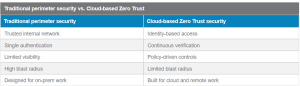
Through a unified policy engine like Microsoft’s Conditional Access, organizations can dynamically grant just-in-time access to resources based on contextual factors like user risk profile, device health, location, and requested permissions. This layered approach strengthens cloud security by reducing attack paths and containing the impact of potential breaches.
Traditional perimeter security vs. Cloud-based Zero Trust
Implementing such a solid law firm cybersecurity framework is only possible with a modern, cloud-based technology stack. For law firms, this means moving beyond perimeter-based defenses and adopting cloud-based security capabilities that support identity-driven access, continuous monitoring, and automated response. These capabilities are difficult to achieve consistently using on-premises or fragmented systems.
By migrating to the Microsoft cloud on Azure, law firms gain access to an entire suite of deeply integrated security solutions aligned with the Microsoft Zero Trust Model. From advanced threat analytics to holistic compliance tools, Azure provides an unparalleled level of protection against modern cybersecurity threats.
Because Microsoft operates cloud infrastructure at global scale, it can sustain long-term investment in security research and engineering that would be difficult for individual firms to replicate independently. Microsoft employs thousands of security specialists and commits significant ongoing resources to securing its cloud services. For law firms using Azure, this translates into access to continuously updated security capabilities without the burden of building and maintaining equivalent safeguards in-house.
In today’s unforgiving cyber landscape, taking a reactive, perimeter-based approach to security is the equivalent of legal malpractice. The Microsoft Zero Trust Model, delivered through secure cloud platforms, provides a practical framework for enforcing identity-driven access, limiting blast radius, and maintaining consistent control across environments.
For law firms evaluating their security posture, the next step is not simply adopting new tools but reassessing whether existing approaches still serve the business. Understanding how Zero Trust and cloud security apply to your firm’s risk profile, data landscape, and regulatory obligations is a critical part of that process.

sa.global empowers law firms to achieve more by addressing challenges through industry expertise and Microsoft Cloud-based solutions.