sa.global: Predictable client engagement strategies for professional legal service delivery
sa.global | Resource | 26 October 2026
In today’s legal marketplace, the difference between a successful law firm and a struggling one often comes down to client experience. Yet, many firms focus on legal service delivery outcomes while overlooking the ecosystem of interactions that shape client perception every day. The process by which law firms engage their clients influences trust, retention, referrals, and ultimately the business’s long-term health.
This blog explores client engagement strategies that help law firms deliver consistent responsiveness, clarity, and professionalism across matters, teams, and offices.
Before diving into execution, it helps to clarify what is client engagement in a legal services context.
Legal client engagement is the ongoing process of keeping clients informed, involved, and confident throughout the lifecycle of a matter. In practice, this includes:
- Clear communication at every stage of a matter
- Predictable response times
- Easy access to documents and updates
- Regular checkpoints that align expectations
Research shows that 82% of clients consider clear communication essential to their overall experience with legal services, reinforcing the idea that engagement is shaped as much by how firms communicate as by the outcomes they deliver.1
1. Standardize communication without losing the human touch
76% of legal clients cite responsiveness as a top factor influencing their satisfaction,2 making response times and communication standards critical components of effective client engagement strategies.
A more reliable approach includes:
- Defined response time expectations across the firm
- Standard templates for common updates, adapted to the matter
- Clear ownership of client communication responsibilities
This structure does not remove personalization. It ensures that clients receive a consistent baseline experience, regardless of who is handling their matter.
2. Map the client journey across the matter lifecycle
A typical client journey includes:
- Initial enquiry and onboarding
- Active matter work and milestones
- Billing and administrative interactions
- Matter closure and follow-up
By plotting expected touchpoints such as status updates, milestone notifications, and billing explanations, firms can identify moments where clients are most likely to feel uncertain or disengaged. These friction points often include extended periods of silence, unclear next steps, shifting timelines, or unexpected billing queries.
Addressing these moments proactively strengthens legal client engagement without increasing effort. The result is a more predictable, transparent experience that builds confidence and reduces reactive follow-ups.
3. Build feedback into the process, not just the end
Waiting until a matter closes to ask for feedback limits its usefulness. More effective firms gather insight during the engagement itself.
Practical methods include:
- Brief check-ins at key milestones
- Targeted questions after major deliverables
- Simple feedback forms embedded into client interactions
These inputs help teams course-correct early, rather than discovering issues when it is too late to act.
4. Shift from reactive to proactive updates
One of the most effective client engagement strategies is setting expectations upfront and meeting them consistently.
This means:
- Sharing timelines and milestones early
- Providing regular progress updates, even when there is no major change
- Explaining delays before clients have to ask
Clients rarely expect constant updates. They do expect predictability and transparency.
Individually, these approaches improve how firms interact with clients. At scale, however, they quickly become difficult to sustain without shared systems and structure. This is where many firms struggle, because execution depends too heavily on manual effort.
Even the most well-defined client engagement strategies break down without systems that enforce consistency at scale. In many law firms, engagement still relies heavily on individual effort. Lawyers remember to send updates. Teams manually track milestones. The result is uneven experiences across matters and offices.
To move from intent to repeatable execution, engagement must be embedded into the same operational backbone and law firm software that governs matter delivery. This is where cloud-enabled platforms like the Microsoft Industry Cloud for Law Firms make a tangible difference.
Unlike generic systems, this legal-specific cloud ecosystem aligns engagement directly with matter execution. Updates are triggered by workflow events. Access is governed by role and context. Client communication is anchored to real-time matter data rather than manual follow-ups. This tight coupling between technology and legal operations ensures engagement is consistent, timely, and scalable.
This shift is reflected in a core set of capabilities that strengthen legal client engagement at scale:
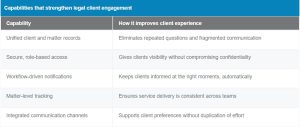
When engagement capabilities are built into core systems, firms gain:
- A single, consistent view of client and matter activity
- Automated communication triggers aligned to legal workflows
- Secure access controls tailored to different client roles
- Analytics that reveal where engagement breaks down
By embedding these capabilities into daily operations, the Microsoft Industry Cloud for Law Firms helps reduce reliance on manual follow-ups and individual discretion. Engagement standards are met by design, not by exception.
The result is a more predictable and professional client experience. Clients know when to expect updates. Lawyers spend less time managing status enquiries. Practice leaders gain visibility into how consistently the firm delivers on its engagement commitments.
Together, these operational and technology foundations transform client engagement from an individual responsibility into a firm-wide standard.
Effective client engagement strategies help law firms deliver consistent experiences without increasing operational complexity. By defining engagement standards, mapping client journeys, gathering feedback early, and enabling these processes through cloud-based legal platforms, firms can close experience gaps that often go unnoticed.

sa.global empowers law firms to achieve more by addressing challenges through industry expertise and Microsoft Cloud-based solutions.