
sa.global – The onboarding problem most CFOs miss, and why it leads to revenue leakage
CFOs attribute onboarding friction to compliance. The commercial exposure the data reveals sits somewhere else entirely, and at an earlier point in the timeline than most firms are looking.
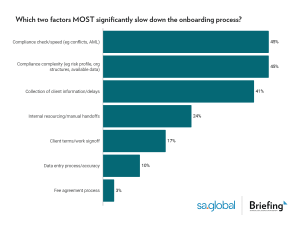
When the Briefing CFO research asked CFOs to name the two factors that most significantly slow down their onboarding process, compliance dominated. Compliance check speed and compliance complexity were each cited by around 50% of respondents. That is the expected answer, and it is not wrong. Compliance is genuinely demanding. AML, KYC, conflict checks: these take time, carry regulatory obligation, and are visible to everyone involved in getting a matter open.
The problem is what that answer obscures. Focusing on compliance as the primary bottleneck directs investment, attention, and process improvement toward the part of onboarding that is already well understood, well governed, and increasingly well served by automation. A comfortable diagnosis, because it points toward a tractable solution: speed up the compliance checks, automate the AML screening, reduce the conflict cycle time. What it does not do is address the commercial exposure the data actually reveals.
The finding that sits beneath the expected answer
Only 3% of CFOs identified pricing and fee agreement as a bottleneck. On the surface that suggests the commercial terms process is running smoothly. The data from the same respondents tells a different story: a small group of around 20% report that commercial terms are often clarified or documented after work has already started, and a further group acknowledge that their process is inconsistently applied, with some matters proceeding before formal documentation is complete.
What this means in practice is that matters are opening quickly on the compliance side while opening with incomplete commercial foundations on the commercial side. The compliance track is being optimized. The commercial track is being left behind. And because the commercial track does not feel like a bottleneck, it does not register as the problem it is.
There is a third diagnostic error beneath these two. Firms are not only investing in compliance speed at the expense of commercial terms clarity, they are also solving for the wrong moment in the timeline. The commercial problem does not start when the matter opens. It starts when work starts. And in most law firms, work starts before the matter opens.
Firms are investing in faster compliance while leaving their commercial foundations inconsistently set. The result is matters that open quickly and bill slowly, with some of the cost already gone before the matter existed.

Where the billing friction actually originates
A matter that opens with ambiguous scope and undocumented fee terms does not generate a visible problem at onboarding. The friction appears three months later, when the first invoice goes out and the client’s recollection of what was agreed differs from the fee earner’s, or six months later when a write-off is approved on a matter that was never going to collect at the agreed rate because the rate was not properly confirmed at the start.
A portion of that friction has an earlier origin still. By the time the first invoice is sent, the matter may already be carrying hidden cost from the pre-matter period: time recorded against nothing, intended for back-allocation, never fully recovered. By then it has been attributed to billing, or to client management, or to fee earner behaviour. Its origin in an onboarding process that treated commercial terms as a secondary concern and allowed work to begin before the matter was ready is rarely part of the diagnosis.
The most consequential finding in the dataset
The mismatch between where CFOs locate friction and where the data shows commercial exposure to lie is the most consequential finding in the Theme 1 dataset. Not because onboarding is broken, but because the standard firms have set for it is aimed at the wrong part of the problem and the wrong point in the timeline. Compliance speed has a process solution. Commercial terms clarity is a data and governance problem and does not respond to the same kind of intervention. The pre-matter time loss is a sequencing problem. Investing in faster compliance while leaving those two unaddressed does not close the exposure. The exposure simply becomes harder to locate when it eventually surfaces.
What addressing the right problem requires
Solving the commercial terms problem is not a faster compliance workflow. It requires a platform where commercial terms, fee agreements, and billing preferences are captured as structured, governed data at the point of onboarding and flow directly into the billing engine without translation or assumption. And solving the pre-matter time loss requires a sequencing control that ensures work begins only when the matter is ready. These are different problems from compliance speed, and they demand different solutions.
Onboarding
Commercial control from before the first time entry
The Onboarding application closes the pre-matter commercial gap that most firms do not track. By structuring every client and matter onboarding step through consistent, governed workflows, it ensures the matter is commercially complete before any work begins. Task dependencies, approvals, and commercial requirements are sequenced and tracked in real time. Fee earners begin work when the matter is ready rather than before it, and the structured workflow creates an audit trail connecting onboarding completeness to billing readiness.
Billing
Commercial terms locked to the billing engine at matter open
sa.global’s billing capability, including power billing, consolidated billing, eBilling formats, and multi-currency support, is built to receive structured commercial data from onboarding. When fee agreements and billing preferences are captured in evergreen at matter open, they flow into the billing process without manual re-entry or reconciliation, closing the gap between what was agreed and what is invoiced.
CRM and pipeline management
Client terms tracked from relationship to matter
The CRM and pipeline management capability tracks the full client journey from prospect to cash collection. Framework agreements, rate cards, and client-specific billing terms are held at the relationship level and carried forward to every matter, so the commercial foundation is established once and applied consistently rather than renegotiated at each instruction.
Empower
Proactive alerts when commercial terms are missing or mismatched
empower’s proactive automation capability flags matters where commercial terms are incomplete or where agreed rates do not match billing instructions, before work is allocated and before the first time entry is submitted. Operating on the clean, structured data the Onboarding application produces, it identifies genuine commercial risk signals. The system notices the commercial problem at onboarding rather than the CFO discovering it at collection.
Efficiency is not the end goal. sa.global’s AI approach is built on the principle that productivity gains alone do not change business outcomes. The commercial terms problem and the pre-matter time loss both require structured foundations first. Connected intelligence runs on top of those foundations.
Explore finance capabilities →