Two tools, Two jobs: How to know which legal AI is right for your work – Draftwise
You paste a redline into a general-purpose AI tool, and it returns clean, confident output in under a minute. The language is reasonable. The risk flags look familiar. What it doesn’t carry is any record of the three deals where your team fought for that exact carve-out formulation and won, what you gave up to get it, or that the other side always pushes back on that clause.
General-purpose tools are built for breadth. The institutional depth that comes from years of your firm’s deal data requires something different.
A useful question
Legal AI is moving fast. Law firms and in-house legal teams are fielding more tool evaluations than ever, and the category is still sorting itself out. Amid all of it, a reasonable question has surfaced: do general-purpose AI legal plugins replace purpose-built legal AI platforms, or do they serve a different need entirely?
The answer? They serve a different need, built for different jobs. The more useful question is knowing which one is yours.
Whose knowledge is powering the AI?
Before comparing feature sets, ask one key question: where does the intelligence actually come from?
General-purpose AI legal plugins run on the model’s general knowledge plus whatever playbook you configure. Each session draws on the model’s general legal knowledge, independent of your organisation’s negotiating history (or even previous sessions).

Purpose-built legal AI runs on your firm’s or organisation’s actual deal history, precedent, and negotiated language. It becomes more accurate the more you use it. When it surfaces a clause, it can tell you where that language came from, how it was negotiated, and whether it held.
Take a leveraged finance carve-out as a concrete example. A general-purpose tool will produce a reasonable clause, but what it can’t surface is your team’s history with that formulation across comparable deals. A purpose-built platform surfaces that history. The difference between the two outputs may look subtle on the page. The difference in negotiated value is not.
This is not a feature comparison. It is a fundamentally different philosophy about where legal intelligence lives.
Who each tool is built for
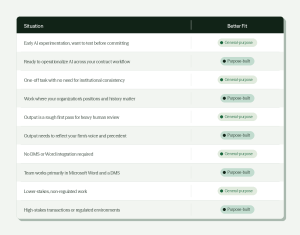
General-purpose AI legal plugins are well-suited to legal teams in the early stages of AI adoption, or those looking for a low-friction starting point before committing to a purpose-built platform. Common use cases include first-pass contract review, NDA triage, templated compliance responses, and regulatory briefings. They are fast to configure, low-cost or bundled into existing subscriptions, and accessible to non-specialist teams.
Three signals you may be ready for more:
- Your output doesn’t reflect your organisation’s past positions
- Your team is losing time copying and pasting between tools
- Consistency across matters has become a priority
Purpose-built legal AI is built for transactional lawyers at law firms and in-house legal teams where the work requires consistency, institutional alignment, and grounding in how your organisation actually contracts. The use cases reflect that: drafting complex agreements from firm precedent, clause-by-clause review grounded in deal history, responding to redlines using comparable past transactions, and surfacing your best-negotiated language at scale.
DraftWise cites back to actual deals. It reflects your firm’s voice and positions. It works natively in Word and integrates with your DMS. The intelligence layer knows what your organisation has agreed to, not just what the law generally says.
Where they overlap, and why that matters
Both tools can review a contract and flag issues. That surface similarity creates real confusion. But the optimization target is different.
General-purpose plugins optimize for speed and accessibility. Purpose-built platforms optimize for precision and institutional alignment. One analogy worth keeping: a well-briefed paralegal who understands contracting versus a senior associate who has read every deal your firm has done in the past five years. Both are useful. Not interchangeably.
These tools are not in competition. They often serve different people within the same legal ecosystem, or the same team at different stages of maturity.