
Unlock smarter LAA contract management with the Legal Aid system from Accesspoint
Your Legal Aid contract defines your capacity and determines how many new cases your firm can take on. In practice, it shapes how you plan, how you allocate work and how confidently you make decisions throughout the year. And yet, in many firms, turning that contract into usable data still relies on manual entry.
For firms using a legal aid management system, the challenge is turning information into something structured, accurate and immediately usable.
So, imagine if you could automatically upload your legal aid contract? Our Legal Aid Manager can.
Keying in all the information from the LAA is a cumbersome process. We’ve resolved this through one quick import: a simple, automatic, AI-powered upload. You can also still edit before uploading (if need be).
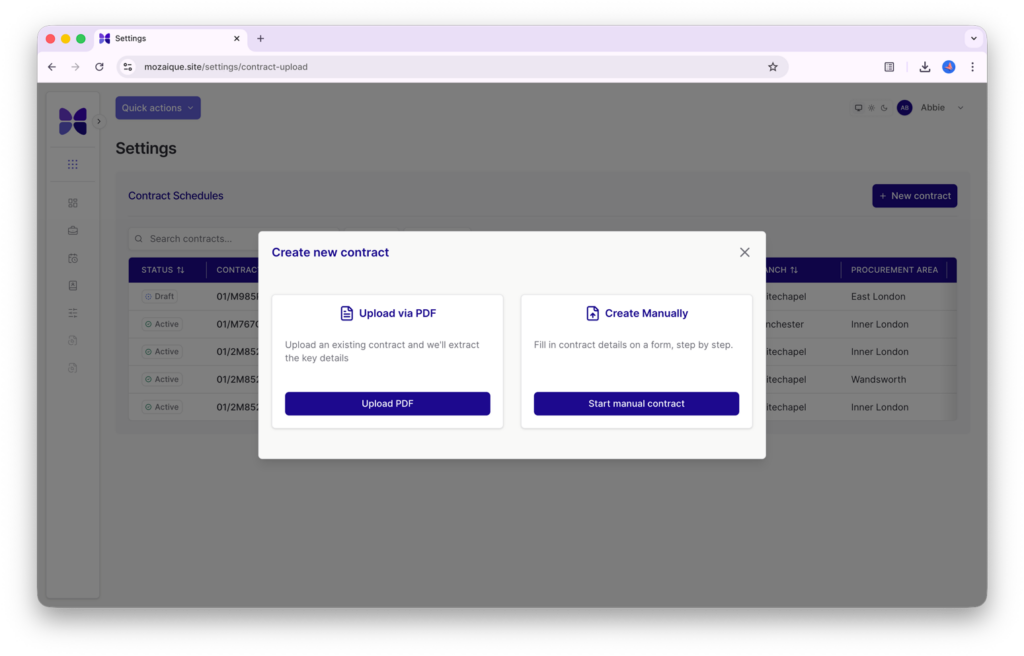
Create a new contract > upload a PDF > drag and drop contract.
When an LAA contract arrives, it usually comes as a structured PDF. The information is clear, but it still needs to be translated into something your system can use. That means extracting contract references, identifying categories of law, and entering matter start allocations field by field. Once entered, the data is checked, and often checked again.

The work itself isn’t difficult, but it’s repetitive and time consuming for legal aid lawyers. Over time, that repetition absorbs hours that could be spent on fee-earning work. At the same time, each manual input introduces the risk that something is recorded incorrectly. On their own, these pressures are manageable, but left to grow over time they build into something that affects how the firm runs.
What does manual Legal Aid contract entry actually cause?
| What it looks like day-to-day | What it actually causes |
|---|---|
| Re-keying contract data | Non-recoverable admin time |
| Double-checking allocations | Operational drag |
| Using spreadsheets to track matter starts | Fragmented visibility |
| Reconciling discrepancies | Data mistrust |
| Manual updates after amendments | Gradual data drift |
A different starting point for Legal Aid software
Our Legal Aid Manager automatic contract upload allows the firm to upload the LAA contract directly. From there, the process moves immediately into extraction. Within a legal aid case management system, this removes the need to treat contract setup as a separate administrative task, embedding it directly into the operational workflow. The system analyses the document and extracts key information, including contract references, legal categories, and matter data.
This information is then presented clearly for review before being confirmed and activated. The contract moves from static document to usable operational data within minutes.
This reflects a broader shift in how legal aid software is expected to operate, in which structured data is generated automatically rather than manually assembled.

What actually happens after you upload the LAA contract?
Once the LAA contract is uploaded, the system works through it. Once confirmed, that data is immediately available across the system, ready to support case creation, time recording, and billing without any additional setup. This is where legal workflow automation becomes practical rather than theoretical, with the contract moving directly into the system as structured, usable data.
You can still review contract data, just without the admin burden
Importantly, this does not remove oversight. Once the contract has been processed, the extracted data is presented for confirmation. Everything can be reviewed and adjusted where necessary, before anything becomes active within the system.
The responsibility remains with the firm; what changes is the amount of manual work required to get there. Within a legal aid case management system, this ensures that contract data is not only accurate but immediately usable across the wider workflow.

What does this change in practice?
When contract data is structured correctly from the outset, the effect is immediate. What was once a static PDF becomes something more useful: a live, structured representation of your contract that stays aligned with how your firm actually works. Once that contract data is structured correctly, firms gain a clearer foundation for managing financial exposure. This is where tools such as the Legal Aid Cost Monitor become critical, helping track how certificate limits are consumed in real time and ensuring that structured contract data translates into controlled billing decisions.